IN FOCUS
Hello Betamax, Instant delivery is increasingly becoming the norm on ecommerce platforms in Indonesia. I found myself choosing this option with all my orders lately. I don’t need PS5 discs or clothes so urgently that they need to arrive at my doorstep ASAP. But the relatively affordable instant delivery fees are hard to resist, thanks to the generous discounts offered by platforms. It’s no surprise that other players are following suit: Shopee and Blibli, for example, recently launched their own services, promising delivery within 30 minutes to an hour. They’ve joined the ranks of several earlier quick commerce entrants including Gojek’s GoMart, GrabMart, KlikIndomaret, and Alfamart’s Alfagift. That leaves Astro as the only pure-play quick commerce company still operating in Indonesia today. In today’s Top Story, I look at Indonesia’s latest quick commerce model, which no longer relies on running dark stores or a large number of hubs. Instead of making such significant investments, platforms are tapping into existing merchant and logistics networks to power their services. While this second-wave model looks more economically viable, its profitability is unproven. Meanwhile, last week’s Tech in Asia Conference in Singapore showed just how strong the enthusiasm for AI is in the city-state. At the same time, Anthropic announced that it will open an office in Singapore next month. My colleague Duc tracked which AI companies have set up shop in the country and what roles they are hiring for. These moves reinforce Singapore’s position as Southeast Asia’s leading AI hub. Jofie Yordan, journalist
TOP STORYQuick commerce’s latest resurgence in Indonesia looks different

Image credit: Ulla
In Indonesia, quick commerce’s second wave is testing whether fast delivery can become a sustainable part of mainstream ecommerce without the costly dark store infrastructure that sank earlier players. The shift also raises a question: Does instant delivery create new shopping occasions? Or does it simply move existing purchases between ecommerce platforms and offline retailers? China’s experience shows how instant delivery could evolve into a tool to drive up shopping frequency beyond urgent grocery purchases. However, Indonesia’s fragmented geography and logistics network could limit how broadly that model can be replicated.
A VISUAL STORY YOU SHOULDN’T MISSTracking AI hiring in Singapore: OpenAI, Anthropic, and more 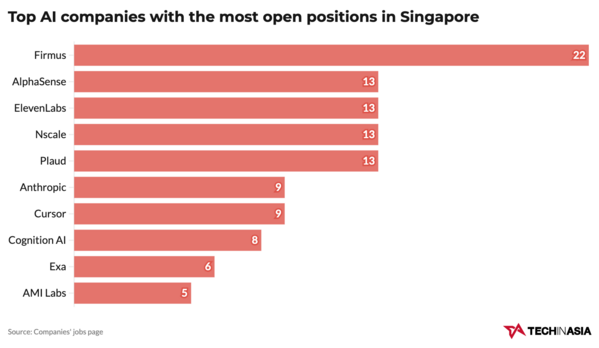
Global AI companies are racing to establish and expand their presence in Singapore. But the jobs they’re creating suggest that the city-state’s emerging role is less about building AI models and more about selling and deploying them across Asia. The scale of some commitments is significant. Databricks plans to invest more than US$350 million and double its Singapore workforce to over 500 employees, while Cursor is eyeing over 200 roles across Asia Pacific from its Singapore base. However, much of the hiring we’ve tracked so far is concentrated in regional sales, go-to-market, partnerships, and customer-facing roles. While that reflects Singapore’s longstanding position as a regional headquarters for global firms, how much of the AI boom will translate into deeper technical capabilities and research jobs locally?
TRENDING NEWS1️⃣ SoftBank launches bond sale for OpenAI investment The Japanese conglomerate launched senior unsecured notes totaling US$10 billion and US$1.15 billion to help fund its follow-on investment in OpenAI, according to a term sheet. The money will also support general corporate purposes and replace a bridge loan facility tied to the investment. 2️⃣ SG-based 01Fintech invests in Indonesian digital wallet Dana The companies said they would explore opportunities including lending and working capital solutions for MSMEs, wider access to products such as microinsurance and digital savings, and cross-border payments. The investment size was not disclosed. 3️⃣ China’s Z.ai faces scrutiny after coding tool uploads local data The company, which builds large language models and related tools, patched ZCode after developers reported that the coding assistant had uploaded local workspace data to external servers without explicit user consent. Z.ai apologized for the incident. 4️⃣ Australian AI firm Firmus plans $5b IPO The firm is looking to raise A$7 billion(about US$5 billion)by listing on the Australian Securities Exchange. If completed, this could be Australia’s second-biggest IPO after Telstra’s A$10 billion (US$7.11 billion) listing in 1997. 5️⃣ Indian fintech firm Moneyview to open $114m IPO It aims to go public on September 24 at 32 rupees to 34 rupees (US$0.33 to US$0.35) per share. Moneyview will use US$33.9 million to support lending operations and US$26.1 million to strengthen the capital base of its non-banking financial company subsidiary.
WHO'S HIRINGYou can post a job here or search for jobs here.
|