Hello Betamax, The same people who fueled the AI race have recently been the ones pushing to slow it. First, Anthropic CEO Dario Amodei made an extraordinary call for labs to slow frontier development as security concerns mount. OpenAI’s Sam Altman and xAI’s Elon Musk backed him. Then markets reacted soon after, sending AI “picks-and-shovels” stocks lower, including Asian chipmakers Samsung and SK hynix. But few expect development to stop. US President Donald Trump swiftly dismissed the idea, while Nvidia’s Jensen Huang and Meta’s Mark Zuckerberg opposed a coordinated slowdown. South Korea said it could not afford to fall behind either. Critics say a US slowdown would allow Chinese labs to catch up. Supporters counter that American labs can afford to “pace the frontier” because they control the leading models and much of the compute, while Chinese rivals still rely heavily on distillation. Even if frontier development continues, however, new model releases could slow as American labs conduct more testing and add safeguards. To labs in India, Southeast Asia, and Europe, that might look like a rare chance to catch up. Slower releases would give them more time to improve their models and could, in theory, free up computing capacity. That could lower token costs, making AI more affordable and accessible in price-sensitive markets like India and much of Southeast Asia. But that opportunity may prove illusory. US dominance rests partly on its companies’ control of vast amounts of compute. A slowdown would not weaken that advantage but could reinforce it.

Image credit: Made by Ulla/Tech in Asia with the help of AI
Manoj Sukumaran, an independent AI and chip analyst based in India, says compute could become even scarcer as frontier labs put more resources into making emerging models safer. The US could also restrict foreign access to powerful models, as it briefly did with Anthropic’s Fable 5 and Mythos 5. Hence, the “pacing of frontier development” that Amodei called for is ikely to widen the gap between AI haves and have-nots. This edition also features an interview with the cofounder of AI startup Flam, fresh off a fundraise. Pranav Balakrishnan, AI reporter Editor’s note: Starting next week, The Prompt is going twice weekly. On Mondays, we’ll dive into one big AI issue and offer our take – because original human thought is still in high demand. On Wednesdays, our news-focused edition will bring you the AI developments across Asia and beyond that are worth watching.
TOP AI READS FROM OUR DESK1️⃣ Last to board: why travel may be AI’s final frontier
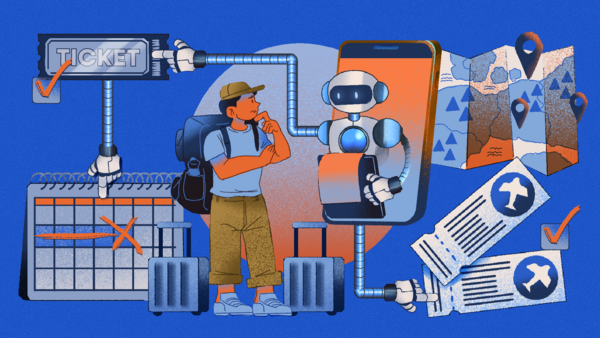
Image credit: Ulla
Travel looks tailor-made for agentic AI. Planning a trip involves comparing options, coordinating bookings, and making decisions, which are precisely the tasks agents promise to handle. Yet adoption within the industry remains limited. While 90% of travel executives say their organizations use generative AI in some form, only 2% have widely deployed agentic AI, according to a McKinsey survey. Travel was bracing for disruption that never landed. Instead, AI has run into an industry constrained by fragmented systems, complex rules, and high costs. That has protected incumbents and given them little incentive to move quickly. Payments, booking systems, and live inventory must all work together before an agent can manage a trip seamlessly. Until then, travel may remain one of the last parts of online retail to become truly agentic. 2️⃣ Agents – not humans – have picked the next $100b company Last week, we hosted the 15th edition of our flagship Tech in Asia Conference in Singapore, where tech leaders from around the world explored the future of AI and how businesses can deploy it meaningfully. One of them was Paul Copplestone, CEO of data-hosting platform Supabase, which finds itself at the center of an AI gold rush. Vibe coding startup Lovable is now one of its biggest customers. When vibe coding took off a couple of years ago, Supabase initially thought it was under attack. The number of new databases being created on its platform had suddenly exploded. This year, Supabase raised US$500 million in a GIC-led round at a US$10.5 billion valuation. Copplestone wants to build a US$100 billion company, but the customers that take it there may not be humans. They may be AI agents. Also at the conference, GoTo CEO Hans Patuwo offered a refreshing and pragmatic take on AI. While most tech CEOs tout its endless possibilities, he said GoTo is narrowing its bets after two years of experimentation. “We are not trying to solve world hunger,” Patuwo added, making the case for smaller, cheaper models that do the job.
WHAT ELSE WE’RE THINKING1️⃣ Singapore is hitting AI escape velocity The city-state had quite an AI week. Anthropic announced a new office, Databricks and Plaud pledged fresh investment, and Waymo is bringing robotaxis to the city-state. Why does everyone suddenly want a piece of Singapore? It has become a rare sweet spot: a neutral base in the US-China AI race, deep-pocketed enough to build the infrastructure, and people are actually using AI here. The city-state ranks second among 121 markets for Claude use relative to population. About 90,000 public officers use the government’s Pair AI assistant each month, while Microsoft estimates that 60.9% of the working-age population uses AI. None of this happened by accident. Singapore spent years pouring money into compute, research, and AI safeguards. Now comes the payoff. The government built the runway, and users showed up. AI companies are already piling in, and the city-state’s AI flywheel is starting to spin. 2️⃣ Will AI keypads catch on? A newer category of hardware is being built around AI itself, with developers among its earliest targets. And no, I’m not talking about the iPhone. OpenAI has already shipped its first hardware device – I’m not sure anyone noticed. In July, it launched Codex Micro, a US$230 keypad for developers, designed with Work Louder. The limited run sold out within 12 hours, but few developers I know are talking about it. Codex Micro does not replace the keyboard but reduces reliance on it: Light-up keys track agents, while users can switch between them, dictate prompts, and adjust their reasoning. For years, developers were glorified typists and translators, turning business needs into requirements and code, Ajey Gore, Gojek’s former group CTO, recently said in Bengaluru. AI is commoditizing both tasks. “You are built to think,” he said. “You are not built to type.” These keypads offer a glimpse of that future: Developers type less and spend more time directing fleets of agents. Logitech recently rolled out something similar in India. Its MX Keypad helps developers switch between Claude Code, GitHub Copilot, and VS Code. It also allows them to monitor agents and automate tasks.

Photo credit: Logitech
The pitch is productivity, but the problem is habit. Valeriya Kostyukovskaya, Logitech’s global business and marketing manager for MX, told me on the sidelines of the launch that the device has a learning curve. Users need to customize it as well. A developer demonstrating the device also acknowledged that it had taken him time to really make use of the device. This is a tough hurdle for an accessory designed to save time. Codex Micro’s sellout reflects curiosity, but not a change in behavior. And it may take even longer for these devices to spread beyond the developer crowd to the rest of us.
FOUNDER FOCUSWe speak with AI founders and executives about AI, startups, and whatever else is on their minds. In this edition, Tech in Asia sits down with Shourya Agarwal, co-founder and CEO of Flam, which builds tools for interactive advertising and commerce. Think of a jewelry digital storefront where shoppers can change the earrings being displayed, or a digital salesperson they can speak to. Flam builds both the tools to create these experiences and the software that delivers them to users’ devices. Following a US$40 million series B round, the company plans to invest further in its own AI models. But with so many models already available, what does Flam need to build itself? The interview has been edited for brevity and clarity.
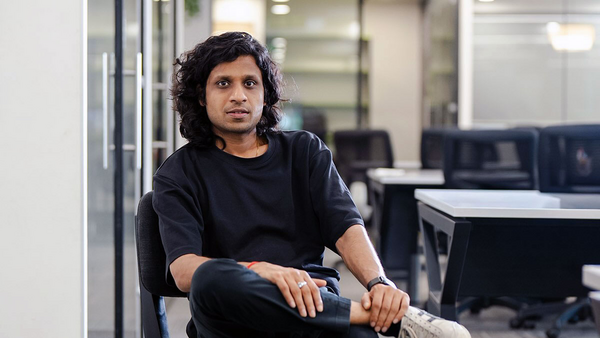
Flam co-founder and CEO Shourya Agarwal / Photo credit: Flam
What does interacting with Flam’s content actually look like? Is this essentially augmented reality? Augmented reality is a small part of our product suite. We have different configurations, and they don’t all use the phone’s camera. With Airboards, you consume content through the camera interface. You can move your phone around and pinch to zoom. In the headphone example we showed you, you can tap a headphone to bring it up and move closer to inspect it. Then we have Flicks, which lets people interact with a video on a website or application. In the jewelry example, you can select different earrings and change what you see in real time. The third product is Visual Agents. These are characters that people can have a conversation with. We combine the face, voice, and knowledge base so the character can respond to you. Here’s the common idea: You don’t have to just passively watch the content – you can interact with it through touch or voice. Those experiences involve capabilities that other AI companies also offer. Why develop your own models instead of using theirs? We would have loved to use existing models. If I were building a text chat interface, I would directly use OpenAI. I wouldn’t spend time thinking about building my own language model. But latency becomes a challenge when you’re talking to a visual agent. If you ask me something and I take three seconds to respond, it feels weird. When you type something into a chatbot, you may be okay waiting five seconds. Expectations are different when you’re looking at someone and talking to them. You have to combine speech recognition, the language model, and speech generation. The delays add up. We wanted to use existing providers, but they weren’t meeting our latency requirements. Our visual agents can respond in less than 800 milliseconds because we control the entire system. That doesn’t mean we build every model from scratch. Of our six models, four are built and trained on open-source models. For the other two, Fantom and Flash, we own the architecture and plan to release research papers. The training is specific to the task. For example, Fable generates video with a transparent background, while our conversational models are trained for fast, multilingual interactions. You’ve earmarked some of the new funding for research. What would that enable beyond the products you’ve just described? Around 30% to 40% will go toward engineering and R&D. We’re also investing heavily in enterprise sales and partnerships. One capability we’re introducing is visual responses from our agents. Instead of answering a question only verbally or through text, an agent can show something relevant to the conversation or present information graphically. For example, if you’re talking to a jewelry agent about rings, it can show you a ring. If you ask for data in a graphical format, it can generate that response. We also want agents to execute actions. For a banking use case, that could mean helping fill out a form. The enterprise defines the workflow and the tools the agent can use. How does a brand turn its existing content into one of these experiences, and what does it pay for? Take a jewelry website. A product page might currently have an image of a ring and a video. The brand can add a Flam view of that product. In our creation platform, you upload the image, connect it to the generation model, and write a prompt describing what you want. You generate the content and then publish it through the Flam platform. Creation uses tokens. For streaming, customers pay based on the minutes of content consumed. If someone talks to a visual agent for 10 minutes, that is 10 minutes of usage. Enterprises buy packages of minutes, and the same principle applies to Airboards and Flicks. That gives us opportunities to expand within an account. A company might start with marketing then extend into its product catalog or add a visual agent to the same website. Other uses include internal communications and learning and development. Google started as your customer and is now a partner. How has that relationship developed, and how big an opportunity could it become? Google became our customer about 18 months ago, starting with marketing for Pixel. It then expanded into other products, including YouTube, Shorts, Gemini, Search, and Maps. The relationship also moved into retail. For Pixel phones in India, shoppers can scan a code and talk to a visual agent about the product. Now we’re working with Google on a joint go-to-market effort in the US. It advises its agency partners and is recommending Flam to them. The tech giant is initially opening this up to a portion of its US advertising business that we put at around US$15 billion. If we could convert 1% of that spending to Flam, that would represent US$150 million. We’re hiring at least 50 enterprise salespeople to support the partnership. Google doesn’t take a revenue share from us. Its incentive is for brands and agencies to spend more on its advertising platforms. We provide another content format they can use, while the media spending goes to Google.
Catch up on past issues of the newsletter here. In the meantime, if you have any feedback or ideas, feel free to get in touch with Huong, our managing editor, at huong@techinasia.com. |